Thursday, February 5, 2015

Truly Too Hot For Jacobin!


The other day on Facebook, my Jacobin colleague Connor Kilpatrick posted an excerpt from an interview with prison scholar Marie Gottschalk. Gottschalk has a new book out called Caught: The Prison State and the Lockdown of American Politics that looks to be very much worth reading.

In the interview, she points out how, despite large racial disparities in incarceration rates, even whites in America are imprisoned at far higher rates than the populations of most other rich countries.

Gottschalk is right. Which reminded me of something that came up during the Charlie Hebdo debate. Some people at the time were circulating articles reporting that 60% or 70% of French prisoners are Muslims. In fact, these were basically guesses since France doesn't collect data on the religious affiliations of detainees. (Which doesn't necessarily mean they're wrong).

The argument went that by comparing those stats with analogous U.S. figures it could be said that the "racial" bias against Muslims in the French criminal justice system is even worse than the bias against blacks in the U.S.

So I went looking for actual stats on French prisoners, and compared them with U.S. data. Here's what it looks like:


It turns out it's true -- the black-white incarceration ratio in the U.S. is lower than the North African immigrant-native ratio in France. But that's only because so few native French are in prison. 

Which raises a larger issue.

I remembered finding something surprising in the U.S. stats when I looked at them a while ago. It turns out that the smallest racial disparities in U.S. imprisonment rates are in the Deep South, while the largest are in states like New Jersey and Connecticut. Not quite what you'd expect, right?

What to make of that surprising fact? I have no problem believing that the New Jersey and Connecticut justice systems are racist. What I find hard to believe is that those in Alabama and Mississippi are far less racist.

So after looking at the French numbers, I decided to do a little statistical analysis. I found that the degree of racial disparity in U.S. states' incarceration rates is almost entirely a function of how low the white rate is. It's completely unrelated to how high the black rate is. (R-squared is 54% for the white rate, 5% for the black rate.)

Racial disparity in overall incarceration, it seems, is a pretty useless way to measure the bias of a criminal justice system. What seems to be the case, rather, is that the more punitive a justice system gets, the more the experience of incarceration starts to affect people outside the very lowest ranks of society.

The result is a paradox: the higher a state's overall incarceration rate, the smaller the racial disparity. Here's what that looks like:


So suppose, tomorrow, the government were to blindly adopt an across-the-board cut in statutory sentencing standards for every crime. The result would surely be a massive drop in incarceration, for both blacks and whites. But also, it seems, a big increase in the level of racial disparity. Food for thought.

Thursday, January 15, 2015

"If Charlie Is Racist, Then I Am," by Zineb El-Rhazoui

In December 2013, former Charlie Hebdo editor Olivier Cyran, who had left the magazine in 2001, published an article, “Charlie Hebdo, Not Racist? If You Say So,” on his website Article11.

Charlie Hebdo’s religion editor, Zineb el-Rhazoui, replied in an essay published the same month. I’ve translated her essay below. When the attack on the paper’s offices occurred, el-Rhazoui was traveling in Morocco.


"If Charlie Is Racist, Then I Am"

Zineb el-Rhazoui

On December 5th, I learned in the press that I have a terrible disease. The diagnosis, by Olivier Cyran on the website Article 11, is definitive: I am racist. Being of French citizenship, I was anxious to identify, before the malady could advance any further, which races were likely to activate my white-woman antibodies. My suspicions naturally gravitated to the descendants of those exotic hordes who are said to be invading Old France to steal our bread, my bread. The Chinese? I've received no Asian complaint on this score. The blacks of Africa and elsewhere? That happens to be the color of the man I love. The drinkers of vodka? I just came back from a year's exile in Slovenia and don't especially remember being allergic to Slavic charms. Who then? "Whites"? I wouldn't venture to think Olivier Cyran could adhere to the theory of "anti-white racism." No. I didn't have to make it far into the piece to be reassured that his diagnosis was more precise: my racism, thank God (that idiot), is only aimed at Muslims, and I  contracted this dangerous syndrome from the editorial staff of Charlie Hebdo. An occupational illness, then. Since Olivier Cyran is himself a veteran of the shop, though I never had the pleasure of meeting him -- since he had the luck, and the balls, according to him, to get out before the infection could spread  through the paper -- I've decided to address him as tu, since we use tu among colleagues at Charlie.

Olivier, you start from the premise that the Muslims of Azerbaijan, of Bosnia, of Malaysia, Egypt or Burkina Faso, represent a single whole that can be designated as a "race." Well, it so happens that that's the one I belong to. The fact that I'm an atheist, and proud of it? It makes no difference, since you don't ask us what we think; you talk about racism, and therefore race. I won't keep beating around the bush, since I don't doubt for a second that, like me, you perfectly understand the distinction between a religion and a race. If you make this lamentable conflation, it's because you engage in a sociological fallacy whose origins lie in the demography of France: our Muslims are most often those we call "Arabs." I'm sort of starting to understand why you speak of racism. But let's try to be precise: we're not talking about the Arabs of Lebanon, who are rarely encountered in the French projects, nor the persecuted Arab Ahwazi minority of Iran, whom nobody in France talks about, and certainly not the Arabs of Qatar who keep Louis Vuitton in business. No, you're talking about the "Arabs" of North Africa -- and here again, it so happens that that is the "race" from which I spring. Moreover, for your information, those "Arabs" aren't always Arabs. The best-informed people in France know that they are Berbers, a word of Greek origin, "Bearded," which refers to us Amazighes, Imazighen -- Free Men, as we like to call ourselves. I am thus triply qualified to dispel the obvious confusion you manifest when you identify those you claim to be defending: the Muslim race.

Muslim You Will Stay

Among the individuals that you assign to this racial category, there are militant atheists like me, obviously secularist (laïque). There are atheists who have other fish to fry, they are secularists too. There are atheists who love Charlie Hebdo and support it; others less so or not at all. There are agnostics, skeptics, free-thinkers, deists; they are secularists as well. There are believers who are non-practicing but politically Islamist, practicing but secularist, or even those with "no opinion," whose daily lives do not suffer because of Charlie Hebdo. There are converts to Christianity -- and oh, are they secularist, for they've endured the terrors of theocracy in their countries of origin. And finally there are the fundamentalists (intégristes), the militant Islamists, the adherents of an identity defined above all by religion, and those are the ones you have chosen to defend. Those are the ones who, given the reality of  French laïcité, have no other choice than to cry racism, a tear in their eye and a hand on their heart, on the pretext that their "religious feelings" have been mocked by a drawing in Charlie. Among them you will find many who stand for laïcité in France but vote Ennahda in Tunisia, who do their shopping at a Parisian halal butcher but would cry scandal if a misfit decided to open a charcuterie in Jeddah. Who are outraged when a day care center fires a veiled employee but say nothing when someone they know forces his daughter to wear the veil. They are a minority. But they are the standard to which you have chosen to align the identity of all of us.

Enough generalities, which I didn't think a man of the pen needed to be reminded of. If I've taken up mine to answer you, it is not solely to defend myself from racism, but above all because in my journalist's memory I have rarely resented an opinion column as much as I did yours. If you will allow an "Arab" to address her own complaint, let me tell you that your rhetoric and arguments are the most sophisticated variety of racism that exists in France. Rare are those today who would risk shouting from the rooftops,"Ragheads Out!" The extremists who would do so would immediately be jeered by you, by me, and by a majority of the French people. First of all, you quote Bernard Maris, Catherine, Charb, Caroline Fourest. What about me, what about me! You preferred to omit my name, when it was my articles that you pointed to as dangerously "Islamophobic," thus, according to you, necessarily racist. Frankly, I wondered why , and I see only two options. Either you didn't want to let Charlie Hebdo's detractors (who can only subscribe to your thinking if they never read the paper) know that the author of these racist ravings belongs precisely to the Muslim race. Or you simply didn't think that, as a person, I was worth naming, since in a fascist rag like Charlie I couldn't be anything but the house Arab. I must have been hired as an alibi, so that Charlie could hit its diversity quota, but you could never imagine that I could be brought on staff for the same reasons that you were. An Olivier, of course, is hired for his professional qualities; a Zineb is only hired by affirmative action. Or maybe you "spared" me because in my case you have no personal scores to settle, unlike a fair number of your former colleagues. In that case, I would have readers seek the motives behind your article somewhere other than the realm of ideas.

Racism By Omission

A Zineb who spits on Islam, that's beyond you, isn't it? It disconcerts you so much that you preferred not to name me, so as not to introduce any doubt as to the veracity of your accusations against us, the journalists of Charlie. If the expression "spit on Islam" shocks you, let me answer you on that too. Why the hell is a "white person" who spits on Christianity an anticlerical, but an Arab who spits on Islam is alienated, an alibi, a house Arab, an incoherence that one would prefer not even to name? Why? Do you think that people of my race, and myself, are congenitally sealed off from the universal ideas of atheism and anticlericalism? Or is it that you think that unlike other peoples, our identity is solely structured by religion? What is left of an Arab when he no longer has Islam? To listen to you, a person like me must be some kind of harki of the Koran, we are traitors so profoundly stricken by a racial complex that we harbor a single regret, that of not being white. As for me, my interactions with Muslims and Arabs did not begin with the [1983] Marche des beurs. I'm what is called a blédarde, born in Morocco to an indigenous father and French mother. It's there that I was educated and began my career as a journalist in a weekly paper that was shut down by the regime in 2010. My colleagues from the old country can explain to you how, in 2006, the Moroccan police state, which had other scores to settle with us, organized a fake demonstration of Islamists in front of the office of the Journal Hebdo, which was accused of having published Charlie's caricatures. In reality, it was a photo of a random person seated at a café terrace holding a copy of Charlie Hebdo. I can also tell you that your piece in Article11 was posted on Moroccan websites, the same kind of sites that would never dare to poke their noses into a corruption scandal involving the King, for example. I won't hide from you that on this one you managed to make not only the Islamists happy but also the Moroccan dictatorship that forced me and several of my colleagues into exile, and which continues to harass us as traitors to the nation, henchmen of foreign powers hostile to Morocco, even to Islam. A piece like yours is worth its weight in gold to the royalist police agents, who sponsored a "dossier" against Charlie published in a gutter newspaper in Casablanca. It informs readers that, among other things, the Molotov cocktail attack on Charlie's offices in November 2011 was an insurance fraud, and that Charb drives a Ferrari thanks to all the dough we make. I don't know if you've heard from Charb since you left the paper, but he still hasn't passed his driving test. In another Moroccan article on Charlie, I learned I'd been hired because I had slept with Caroline Fourest and that my reporting was financed by the Algerian, Spanish, Israeli secret services. Clearly a raghead can't really be hired for the same reasons as an Olivier.

My friend, I know you have nothing to do with the whole journalistic sewer that serves the Mohammed VI dictatorship. I simply want to show you who you're making happy, if my pieces on Islam might occasionally please a few members of the FN.

You see, Olivier, as a blédarde born in the Maghreb, assigned against my will to a religious pigeonhole, not only by you, but above all by a theocratic state that does not allow me to choose my faith and which governs my personal status by religious laws, I have always wondered why guys like you lie down before Islamist propaganda. The laws of my country do not grant me a quarter of the rights you acquired at birth, and if I were to be attacked or raped in the streets of Casablanca by a barbu, as has been promised in hundreds of emails -- never taken seriously by the Moroccan police -- the websites that posted your article will definitely say I was asking for it because I don't respect Islam. And you here in France, in a secularist state, you rehash without grasping its implications this whole moralizing discourse about how one must "respect Islam," as demanded by the Islamists, who do not ask whether Islam respects other religions, or other people. Why the hell should I respect Islam? Does it respect me?  The day Islam shows the slightest bit of consideration to women, first of all, and secondly to free-thinkers, I promise you I will rethink my positions.

The FN? Don't know them.

It is in order to see that day come that I fight alongside all the atheists of Morocco, Tunisia, Egypt or Palestine, not to give pleasure to the FN as you explain in your article. Because believe me, a lot of virulent atheists in the Arab world, so virulent they regularly spend time in jail for blasphemy, have never heard of Marine Le Pen, and could not possibly care if what they say pleases the French far right, because they're busy fighting their own far right: Islamism. If you will permit us, we "Islamophobes" of the Muslim race think the liberation of our societies will necessarily come through emancipation from the yoke of state religion. Since that is what Islam is more or less everywhere in the so-called Arab countries, you'll also find there a strong opposition to theocracy, which is fed not only by the universal idea of separation of church and state but also by the skepticism and historicization of Islamic texts. We permit ourselves just about anything, such as, for example, thinking that Mohammed, and even Allah, are not unrepresentable. Caricatures, parodies of Koranic verses or hadiths, you just have to look around on our internet forums to see that Charlie was not the original source on this score.

You've got to understand us, because you see, centuries after his death Mohammed is still imposing his law. He is, in a manner of speaking, the head of state of this Umma that deprives us of our freedom of thought, and which forbids me, for example, to inherit property equally with my brothers or to marry a man of my choosing. Why would you -- you, an anti-authoritarian -- want a man with as much power as him to be exempt from critique? Because, when I speak to you of laws, I am not referring to obsolete Koranic decrees but to the positive laws in our countries, to the civil code that governs our marriages, divorces, inheritances, child custody, etc. Yes, it's Mohammed, in the name of Allah, who decides, and not us, free people who are equal to you. Let me tell you that for all these reasons, it will not be the official representatives of the Islamic denomination in Europe, whose platitudes you adopt, and who themselves take good advantage of the joys of secularism, who will fix the limits of our freedom of expression. Make no mistake, Olivier, because antiracism is on the side of Charlie Hebdo, which opens its pages to people like me who cannot speak out in their own country under penalty of prison or attack, and not on yours, you who agree to hand the entire "Muslim race" over to its self-proclaimed clergy. Charlie is aware of the intellectual and ideological ferment that is animating the Muslim world, it has understood that a war is on between freedom and politico-Islamist dictatorship, whether you date it to before or after the Arab Spring, and Charlie has quite simply chosen its camp: ours, its -- that of the anticlericals. If blasphemy is a right for the heirs of Christian civilization, why do you deny it to Muslims? Why is an Islamic state acceptable in Tunisia or Egypt, but not in France? Isn't that what racism is?

The Art of Muzzling Criticism

Far be it from me to force this analysis on you. While it flows logically from your reading, I wouldn't go so far as to say you would adopt it. I've tried to uncover the reason you've fallen into such a trap, and I've found it in the fallacy that serves to cement your argument: "Headscarves, high heels, even a T-shirt made in Bangladesh, none of them matter to me when the person underneath is deserving of respect," you say in your article. The honorable philanthropic intention you demonstrate unfortunately conflates the critique of ideas with the critique of persons. Let's remember that the basis of all sound rhetoric is always to avoid the argumentum ad hominem. Inversely, to abhor an idea must never lead to its personification. Critiquing the headscarf is not the same as humiliating every woman who wears it, any more than critiquing Islam amounts to jeering every Muslim. The veiled women in my family are less sensitive than you on this score. Even though I do not hide my aversion to the bit of fabric they wear on their heads, they understand that it in no way detracts from the affection and respect that I have -- or don't have -- for them, for simply human reasons. In committing this fallacy, you once again adopt the arguments of the watchdogs of Islamophobia. Lacking the religious laws that are their tool of power in Muslim countries, they seize on antiracist laws in France to silence detractors of their beliefs. They are dying to have us admit that critiquing the headscarf means denying dignity to those who wear it, and therefore it's racism. Critiquing Mohammed means humiliating every Muslim on an individual basis, and therefore it's racism. That's their equation, and you, Olivier, you took the bait.

Not me. Because the specter of racism that you fear -- so much so that you anoint the arguments of the Islamic far right and throw stones at your former colleagues, to escape all suspicion -- I do not fear it. It is so absurd to suspect me of racism that even you prefer to suppress my name from your article, though you mentioned all the others.  As the Arab whose name you preferred not to cite, I experienced your piece as racist because you forced me, the Arab, to defend my colleagues, the whites. Why should I have more legitimacy than them to advance these ideas? Why does your article force me to bring up my name and my identity? I would have you think about that. You deny me the right to critique the religion I studied as a mandatory subject in school, from preschool to graduation, and which still today forbids me from staying in the same hotel room as my boyfriend when I want to spend a weekend in Marrakech, on the pretext that we don't have a fornication certificate signed by Mohammed. As for my colleagues at Charlie, they clearly ought to shut up, or draw Christmas trees every time they get the notion to criticize Islamic dictatorship, on the grounds that they're white. Nice definition of antiracism.

If you've read nothing other than Malek Chebel, the most vulgarized exponent of Islam-the-religion-of-peace-and-love, I strongly urge you to buy a Sira book first, to get an idea of the teachings of Mohammed, and you tell me if you still think it's disgusting to critique them. Otherwise, go take a tour of the Salafist bookstores that are popping up everywhere in the Paris region, and tell me if you still think that hatred is on the side of Charlie Hebdo. Furthermore, be aware that the increase in their number over the past fifteen years or so -- the period when Charlie, you say, curiously started to take an interest in them -- in no way corresponds to any demographic explosion of Muslims in France, but rather to an ideological shift financed by petrodollars, involving a radicalized minority of Muslims.

Enlightened Minds, Learn Islam!

You will find many pearls in these books, such as le mariage de jouissance (Zawaj al-Mut’a). Practiced in times of war by Muslims, this unilateral marriage contract -- since it's the conquering warrior who decides -- can last an hour, two hours, or a few days, and is intended to allow Allah's fighters  to drain their balls (sorry for the vulgarity, but it's impossible to call it anything else) during their razzias. It appears that this is what happened in Syria in this byzantine story of "sexual jihad." In your article, you quoted a piece in Charlie, of which I was the author, which addressed this subject and which you described as a "pseudo-investigation" based on an abominable Islamophobic rumor. I concede that neither you nor I were on the ground to witness the practice, given the difficult conditions of journalism in Syria at the moment. But for you it was sufficient that [Saudi preacher] Mohamad al-Arefe denied the fatwa that was attributed to him -- urging that the jihadists be resupplied with women -- for all of this to be unfounded. Do you think the FIS in Algeria, or Al-Qaeda everywhere else, had to wait for al-Arefe? You also refer to another of my articles -- again without naming me -- and quote the teaser to illustrate Charlie Hebdo's dangerous drift towards nationalism. In your opinion, this piece about a group of Belgian Salafists was denouncing the threat of our Christian West being invaded by barbarian Muslim hordes. "Will fries soon all be halal?" I asked. You forgot to mention that the hapless hero of my piece was a [white] Belgian convert named Jean-Louis, a.k.a. "le soumis." This is no issue of racism, but rather of fundamentalism. Since the article came out, the tall redhead was arrested over a recruitment cell for jihad in Syria. You would think I wasn't totally wrong to take an interest in his case.

You see, Olivier, this Charlie Hebdo that was totally not racist when you were working there, but which  inexorably became so after you left it, does not need anti-racist lessons from you, and it's the Arab who's telling you so. Personally, I never worked with [Philippe] Val and I don't know if I would have been able, as you were, to listen to his encomiums to Israel, a racist and colonial state, at every editorial meeting in order to keep my job. For me, it's the pen of Charb, one of the most pro-Palestinian writers in the French press,  with which I find affinity. Charb, because of this lynching to which you are contributing through the confusion of your ideas, is today being threatened by al-Qaeda and lives under police protection. So which side is hatred on?

Salutations collégiales,
Zaynab bint Mohammad ibn al-Mâatî al-Rhazwî al-Harîzî.

Thursday, October 30, 2014

Quick Service Data Journalism from Matt Yglesias

America’s favorite ill-informed neoliberal pundit, Matt Yglesias, has unveiled a masterpiece.

Inspired by the New York Times’ excellent piece about Denmark’s high fast-food wages -- which are maintained by the power of the United Federation of Danish Workers -- Yglesias responded with an article headlined, “$20 an hour minimum wage really would cost a lot of people their jobs.” The sage of Vox believed he had spotted “the crucial fact buried in the 29th paragraph of the article”: namely, that McDonalds has far fewer restaurants in Denmark (relative to population) than we do in the U.S.

Conclusion? “Mandating high wages for fast food workers has more or less the impact you would expect — low levels of fast food employment.” (But also this ass-covering sentence: “Obviously this is not a slam-dunk proof that forcing US McDonaldses to pay Danish wages would lead to the closure of two-thirds of the McDonalds restaurants in the country.”)

Can you really reach that conclusion from a single data point? Is this data journalism?

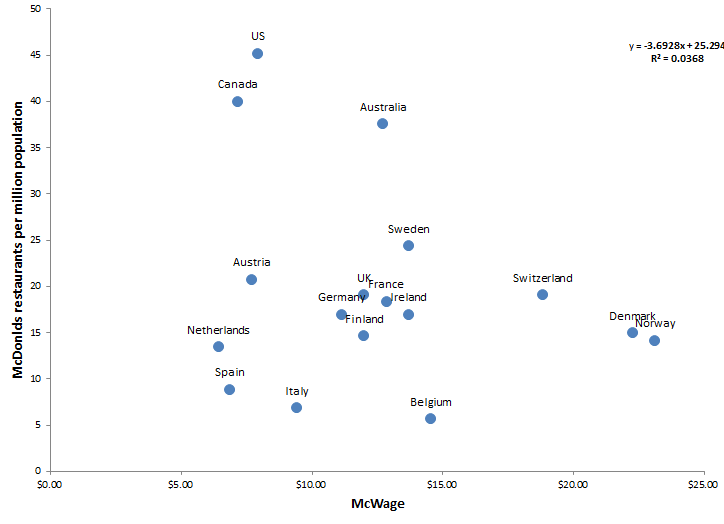
The Times draws on research by Oren Ashenfelter and Stepan Jurajda, who gathered data on McDonalds wages in a number of different countries. As it happens, I noticed the study last year, and decided to look into exactly this question -- how the wage levels found related to the number of McDonalds in each country. It took me a couple hours. Since Vox is so fond of cheap labor, I’m offering my findings free of charge if they want to use them.

Ashenfelter and Jurajda show the “McWage” for a large number of countries: the gross hourly wage in 2007 for McDonalds crew workers, not including benefits or employer taxes. Unfortunately, they haven’t yet reported the actual numbers in tabular form. They only show each country’s McWage as a percentage of the U.S. McWage, and you have to read the figures off their graph, which can be found on page 31 of this, or page 20 of this. Fortunately, this doesn’t present much of an obstacle. 

As for the number of McDonalds restaurants in each country, you can find those numbers for Europe here (page 6); the company reports the numbers for other countries on the websites of its national affiliates.

OK, how do the numbers compare? Here’s a graph:


I’ll just point out the obvious. There is no relationship. 

The U.S. has a very high number of McDonalds, apparently because McDonalds is a U.S. company -- not because it can pay low wages. Canada and Australia have similarly high numbers of McDonalds, despite wages at the same levels as European countries with far fewer McDonalds. Denmark has about the same number of McDonalds as Germany and the Netherlands, despite far higher wages. Etc.

Now let’s try to put some dollar figures on this. Assume that the U.S. McWage was $7.93 in 2007. (That was the highest state minimum wage in the country at the time: Washington state). Then the dollar figures would look like this. (I've left the numbers in 2007 dollars; in today's dollars they would be 15% higher. Also note that in their graph, Ashenfelter and Jurajda compare McWage ratios using market exchange rates, so these numbers reflect that):


Of course, wages are not the only source of labor costs for an employer. There are also benefits and taxes. Let’s mark up the McWage by the average employer payroll tax for a low-wage single worker (data from the OECD), and call that the McLaborCost:


But maybe these numbers are misleading, because market exchange rates don’t always reflect the domestic price structure. So let’s take a different tack. Let’s look at the hourly McWage in each country as a ratio of that country’s hourly aggregate output, with both figures denominated in the same currency. (Hourly output data from the Conference Board.) Here are the ratios:


And here’s the same comparison using McLaborCost, rather than the McWage:


So, no. High wages for fast food workers do not have “more or less the impact” Matt Yglesias would expect. Vox should take down the article.

Tuesday, January 28, 2014

State of confusion

This started out as a comment for Freddie DeBoer's blog, in response to this post -- hence the use of the second person. It got very long, so now it's on my blog too. 

Freddie, the argument of my piece was right at the top – “let’s have a debate over the left and state, but not on the libertarians’ distorted terms.” I’m glad you wrote this response, because it represents just the kind of debate I was calling for -- but also because it’s a good illustration of what I meant by arguing on libertarians’ terms.

You write: “It’s like I said before: I’m left-wing like Fred Hampton, not left-wing like Mayor Daley. I’m with the people who get hit with nightsticks, not people who do the hitting.” That’s a fine sentiment, and I’m 100% behind it -- as long as we stipulate that it’s a bumper-sticker slogan and not anything resembling a theory of the state.

You come closer to formulating a real argument when you say: “A movement that prides itself for speaking for the dispossessed can’t run the risk of romanticizing the state that might help them, as it is precisely that same state that enforces the condition of their immiseration.”

I agree with that sentence too. It’s perfectly true as far as it goes. But logically, you could flip it around and it would still be true. In other words, you could also write: “A movement that prides itself on speaking for the dispossessed can’t run the risk of anathematizing the state that enforces the condition of their immiseration, as it is precisely the same state that might help them.”

If the original statement is true, then the inverted version can’t be any less true.

So we haven't gotten very far. That’s why I’d like to focus particular attention on the way you – and Peter, I think -- use the term “anti-statism.”

You write:

“The anti-statist rhetoric that is the actual target of…Ackerman’s essay…has a long, proud lineage on the radical left. Would Ackerman lump the Black Panther party in with the Rand Pauls of the world? Malcolm X? Eugene Debs? Each of these expressed anti-statist rhetoric so intense that it would make Rand Paul blush.”

Is that true? Would the Black Panthers’ anti-statist rhetoric make Rand Paul blush? I guess it depends on what you mean by anti-statism.

Let’s look at the Panthers’ 1966 Ten Point Program. Point Two, the first programmatic point, after a general statement calling for black self-determination, was: “We believe that the federal government is responsible and obligated to give every man employment or a guaranteed income.”

Point Four was a demand for the construction of housing cooperatives, “so that our community, with government aid, can build and make decent housing.” Another point demanded that the perceived promise made by the Civil War-era Congress, of forty acres and a mule to all freed slaves, be redeemed and paid out to black citizens in currency.***

So I agree with you: Rand Paul would certainly “blush” at the Panthers’ type of “anti-statism.” But above all, he would vigorously deny that it represents anti-statism of any kind.

And here is the crux of my argument: he would be right, and you would be wrong.

“Anti-statism” is a term and a concept that rightly belongs to Rand Paul. It’s useful to him and his ilk because they are trying to promote a vision of politics in which the central question is “how much state?” or “how big a role for government?” That vision of politics is, as I tried to argue in my piece, an “irrelevant monomania at best,” and at worst a rhetorical trap. I’m saying that you have fallen into the trap by accepting the libertarians’ conceptual apparatus.

You perceive our disagreement, I think, as me being “less anti-statist” whereas you’re “more anti-statist.” Is that really the case? I can’t claim to know your opinions on every issue, but I suspect that on most concrete questions we agree. Certainly we agree about NSA spying or whether Edward Snowden should be sent to jail. Like you, I’m sure, I was one of those people cheering on Snowden, hoping Russia would give him a visa, fretting he was about to get handcuffed on a plane in Bolivia.

The real nature of our disagreement is more subtle. Unless I’m wrong, it really stems from the fact that you have – erroneously in my opinion – chosen to acquiesce in a vision of politics as being, in some important way, about “good state” versus “bad state,” and perhaps therefore “more state” versus “less state.” In other words, you’ve accepted the framing of libertarians (and some anarchists). 

And that’s led you to think that there’s a great “anti-statist” tradition on the left running from Debs to the Panthers to Glenn Greenwald. Freddie, I certainly understand what you’re getting at when you say that, but I don’t think that your formulation is the right one.

Go back to the Panthers’ program. In addition to calling for a federal jobs-or-income guarantee and government housing aid, the program also called for an end to police brutality, the freeing of black prisoners, and an exemption for blacks from military service. In other words, it demanded both that the state stop doing things that were oppressive and start doing things that were emancipatory.

You can call that “anti-statism” if you like. But you’d be rendering the term meaningless if you did. It can’t be true that an “anti-statist” is someone who wants the state to do things they like and not do things they don’t like. If that were the case, almost everyone would be an anti-statist.

Now, an anarcho-capitalist, or a “minarchist,” or a certain type of anarchist -- or a libertarian – might be an “anti-statist.” That’s because, in theory, those positions are supposed to be grounded in some systematic opposition to all forms of state activity, some version of “that government governs best which governs least.” Those are genuinely “anti-statist” positions.

But my argument is that those positions have no basis in the left -- or at least not in the socialist left. Now, there is a long socialist tradition of critiquing the class character of the state. That tradition comes in many versions and all of them have pictured the ruling class as having some privileged relationship to the state. While some make that relationship simple and absolute (the state is “ultimately,” or “at bottom,” nothing more than the instrument of the oppressors), others see the relationship, while still privileged, as being much more qualified and contradictory.

The point, though, is that none -- or at least only the crudest -- have simply concluded “state = bad, less state = good.” That would be the truly “anti-statist” position.

To me, you seem to be arguing for that mistaken anti-statist position. But maybe I’m wrong. Maybe I’ve misread you, and it’s the socialist tradition that better represents your thinking, not the “anti-statist” one with its “more state vs. less state” framing. 

In that case, all I’m trying to say is that this difference is fundamental, not incidental, so that when we talk about the state -- and when we talk about various “anti-statists” -- you, we, should make that difference clear.

That’s the kind of debate I’m talking about.


*** Speaking of the Civil War, you might want to look up the incident Eric Foner has called the worst episode of racial violence in all of Reconstruction -- the Colfax Massacre. It was a battle over physical control of a county courthouse between the Louisiana state militia, controlled by black Union veterans, and white anti-incumbent insurgents. In other words, in that particular case I think that you, Freddie, would have been *against* the people getting hit by nightsticks, so to speak, and *for* the people doing the hitting.

Wednesday, November 20, 2013

one more thing about that

UPDATE: Feel free to read this post, but disregard all its numbers and therefore possibly its conclusions. Commenter Erik Hetzner points out fatal problems with the way me and Matt used these data. Two problems: first, "net cost of attendance," the measure Matt used to indicate out of pocket tuition cost, is not the right number. The right number is net tuition. Second, I didn't realize that when the College Board divides families into quartiles they are not evenly sized quartiles, but rather based on arbitrary cutoffs that the CB makes up. This means the calculation I tried to do here is basically impossible with publicly available data, at least as far as I know. Conclusion for now: de omnibus dubitandum.


Just a quick addendum. In that last post, I said you can't argue that making college free would be a windfall for rich kids, because it all depends on how it's paid for. That led to a back and forth in comments and on twitter about how progressive various kinds of state and federal taxes are.

But let's make this simpler and ask: how progressive would a new free-college tax have to be (in a strict bean-counting sense) to make it a better deal  for poor families than the status quo? And the answer is: it wouldn't have to be progressive at all.

That's because the status quo method of college financing, in which poor students have to pay for college but get a discount compared to rich kids, is itself highly regressive, notwithstanding the discount. Let me show you, using some calculations I've done based on Matt B. own numbers:


As you can see, every income group except the richest -- including the poorest -- currently contributes a bigger share of out-of-pocket tuition than their share of total income. What that means is that even if tuition were eliminated and replaced by an absolutely flat income tax levy -- say, a flat 0.5% surcharge for everyone, or a figure slightly higher but with the poorest exempt -- it would still represent a more progressive financing system, in dollars-and-cents terms, than the status quo.

And, I would argue, a more progressive system in lots of other ways too.


Let's not play hard hat versus hippie


Matt Bruenig has been on a jihad about free college. The subject annoys him. I’m not going to speculate about his motives, even though he does a lot of speculating about other people’s motives. His work is generally great, and I think I actually sympathize with some of the basic impulses behind his crusade.

I’m just going to point out as briefly as possible why he is wrong on his central point.  

I take Matt’s central point to be this:
If the class composition of college will not change in response to college being free (which I think historical and contemporary evidence suggests is the case), then making college free will primarily be a windfall for the disproportionately rich kids who will still be the ones in these college spots.

My simple observation is this. Whether or not that claim is true depends entirely on how such a policy is paid for. Rich kids will undoubtedly get a disproportionate share of the free college seats, but they’ll also probably pay a disproportionate share of the taxes.

Let’s be specific. Here is Matt’s chart:


The numbers are a little dated, but the reddish bars show college attendance rates for the generation of kids that was college-aged around the year 2000 (the “79-82” birth cohort). In that generation, 37% of kids from the highest-income families (the top quarter) attended college, but only 13% of those from the poorest families (the bottom quarter) did. In another chart, Matt shows that the net cost of college attendance is almost twice as high (1.85 times as high) for high-income students as for low-income students.

OK, so all of that definitely means if college were made free and there was no change in relative attendance rates, higher-income kids would get a disproportionate share of the benefits.

But what proportion of the costs would they pay?

The only source I know of that estimates the distribution of tax burdens for all levels of government (federal, state, local) is Citizens for Tax Justice. Here is their updated chart for 2013:


According to this chart, the highest-income quintile (the top fifth) pays 65% of all taxes, while the lowest-income quintile (the bottom fifth) pays 2%. (The numbers are about the same if you just look at federal tax data from the better-known Tax Policy Center.) These numbers aren’t strictly comparable with Matt’s college data since they divide the population into fifths rather than fourths.

But it doesn’t really make any difference, because the conclusion is clear. The total amount currently being paid out-of-pocket by the top quartile of college-going families is about five times the total amount currently being paid by the bottom quartile. But the top quintile is paying well over thirty times as much in taxes. (An apples-to-apples comparison of quartiles might knock that figure down to maybe 25 times.)

In other words, unless free college were paired with new taxes that were  far, far  more regressive than the current tax structure, it would represent a clear redistribution from rich to poor.

But that wouldn’t be the only benefit of free college. In fact, the reason I bring this up isn’t solely to cavil over statistics. The general style of Matt’s approach leaves me cold. He has a tendency to strip every question down to a single criterion: how many net consumption-units will the lowest income group have relative to higher-income groups. That’s an important question. But it’s only the overriding question when we're operating in the realm of an Internet Fantasy Policy game.

God knows I have nothing against talking about government policy. But let's not forget that writing out a policy proposal to squeeze out the maximum number of consumption-units for the benefit of the poor doesn’t actually benefit the poor at all -- any more than writing out a proposal for free college does, or, for that matter, having a Twitter flame war about privilege.

If consumption-unit-maximization for the poor is what interests you, the only way to get it is through a real-life politics in which the poor can create some social power for themselves. It should be obvious that systematically casting the interests and grievances of the poor in opposition to the interests and grievances of everyone else is exactly the wrong way to accomplish that.

UPDATE: For some further important points about taxes, see the comment below and my reply.